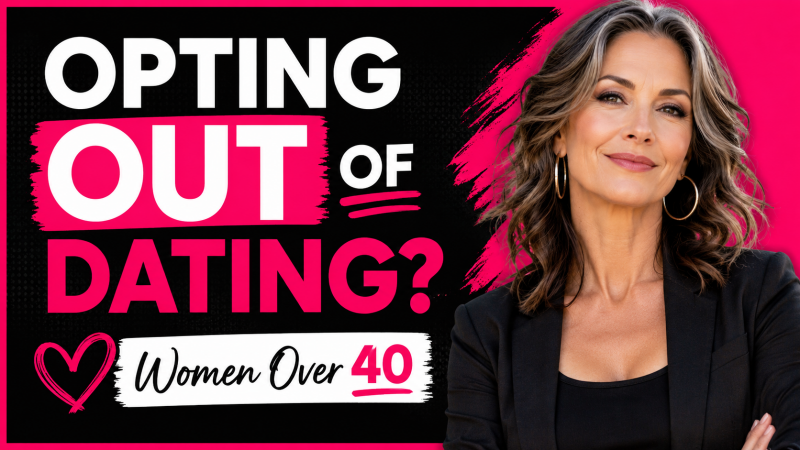

I’ve been coming across quite a few studies and social media posts lately suggesting that more women over 40, and even women under 40, are choosing intentional singlehood by stepping away from dating apps, casual relationships, and incompatible partners. But is this a healthy form of self-reflection(I think so) or can it eventually become avoidance(maybe for some)?
What if a woman isn’t single because she can’t find a man?
What if she simply isn’t looking?
That distinction seems to confuse people far more than it should. Many women, myself included, have been disappointed by love and by men I genuinely hoped would be good choices for me. But I decided I wasn’t going to let a few bad apples spoil the whole bunch. Yes, I know, it’s an old saying, but sometimes the classics still fit.
There is an assumption, particularly once a woman reaches a certain age, that if she isn’t dating, swiping, flirting, entertaining a situationship or at least vaguely hoping Prince Charming wanders into the produce section while she’s examining the avocados, something must be wrong.
Maybe she’s bitter.
Maybe she’s given up.
Maybe she’s “too independent.”
Maybe her standards are too high.
Or perhaps she has finally discovered something wonderfully radical:
Peace is also an option.
And some women are choosing it deliberately.
Being Single and Being Unavailable Are Not the Same Thing
I’ve noticed that we tend to talk about single women as though they are all standing in some enormous romantic waiting room.
They’re not.
Some women absolutely want relationships and are actively dating.
Some would like a relationship but aren’t making it the center of their lives.
Some are taking a temporary break.
And some genuinely enjoy being single.
All of those choices are legitimate.
Increasingly, researchers are paying attention to singlehood as an actual life experience rather than treating it as merely the space between relationships.
And that’s long overdue.
Recent psychological research involving thousands of single adults found that women, on average, reported greater satisfaction with their single status and less desire for a romantic partner than single men.
That doesn’t mean women don’t want love.
It means wanting love and needing constant romantic involvement are two entirely different things.
I think women over 40 understand that distinction particularly well.
After 40, Dating Can Start Looking Very Different
By the time many of us reach our 40s and 50s, we’ve lived enough life to recognize patterns.
We’ve seen chemistry masquerading as compatibility.
We’ve watched attraction convince perfectly intelligent adults to ignore information that should have had them sprinting toward the nearest exit.
We’ve witnessed relationships where one person was doing enough emotional labor to qualify for overtime.
And hopefully, somewhere along the way, we’ve learned something.
For me, this stage of life isn’t about having the most options.
It’s about recognizing which options deserve access to me in the first place.
That changes dating considerably.
When you’re younger, you may ask:
“Does he like me?”
Later, the better question becomes:
“Do I even like what I’m experiencing here?”
Tiny wording change.
Entirely different life.
Childfree Women Have Another Script to Question
For childfree women, this conversation becomes especially interesting.
For generations, women were handed a fairly rigid timeline:
Meet someone.
Get married.
Have children.
Build your entire adult identity around the family unit.
Women who stepped outside that structure were frequently treated as though they’d missed an important train and should immediately begin running down the platform after it.
No, thank you.
One of the beautiful things about being childfree is recognizing that adulthood doesn’t have one correct architecture.
A woman’s life can be built around creativity, friendships, career, financial independence, travel, community, adventure, spirituality, love, solitude or some glorious combination of all of them.
Romantic partnership may be part of that life.
But it doesn’t automatically have to be its headquarters.
There’s a Difference Between Standards and Walls
Now here’s where things get interesting.
I don’t think every decision to stop dating is automatically empowering.
Sometimes we’re protecting our peace.
Sometimes we’re protecting an unhealed wound and calling it peace.
Those are not quite the same thing.
And nobody else can answer that question for us.
A dating break can create enough quiet to finally see patterns that were impossible to recognize while bouncing from one relationship to another.
Why was I attracted to emotionally unavailable people?
Why did I ignore incompatibility because the chemistry was good?
Why did I keep accepting behavior I knew I didn’t like?
Was I choosing partners because I genuinely wanted them, or because being chosen made me feel valuable?
Now we’re getting somewhere.
But self-reflection also requires enough honesty to ask the opposite question:
Have my standards become boundaries, or have they become barricades?
Healthy Solitude Feels Different From Avoidance
I don’t think there’s a magic number.
Six months single isn’t automatically healthy.
Five years single isn’t automatically unhealthy.
A woman could date constantly while avoiding genuine intimacy.
Another woman could spend several years single while becoming more emotionally open than she’s ever been.
The calendar doesn’t tell us much.
The better questions might be:
Does my single life feel expansive?
Am I building friendships, pursuing interests, traveling, creating, learning and participating in life?
Am I genuinely happy?
Not performing happiness for Instagram.
Actually content.
Can I imagine letting the right person into my life?
Not any person.
The right one.
Or does intimacy itself frighten me?
Do I dismiss people before they have a chance to know me?
Do I automatically assume relationships will end badly?
Do I secretly want companionship while convincing myself I don’t because vulnerability feels risky?
Those questions require more courage than downloading another dating app ever will.
A Relationship Should Compete With Your Peace
This may be one of the biggest differences between dating at 25 and dating after 40.
A relationship isn’t competing against loneliness anymore.
It’s competing against the life you’ve built.
Your quiet Saturday morning.
Your friendships.
Your routines.
Your independence.
Your finances.
Your sleep.
Your freedom to travel.
Your ability to make decisions without convening a committee meeting in the kitchen.
That’s some formidable competition.
So when people say women become “too picky” with age, I sometimes wonder whether what they actually mean is:
She has more to lose by choosing badly.
That’s not bitterness.
That’s information.
The Goal Isn’t to Become Unavailable
I don’t want women to become emotionally unavailable.
I want us to become selectively available.
There’s a difference.
You can remain open to love without auditioning everybody who walks through the door.
You can enjoy being single without declaring relationships obsolete.
You can want companionship without accepting inconsistency.
You can enjoy sex without accepting arrangements that leave you emotionally depleted.
You can leave the dating apps.
You can return to them later.
You can meet someone organically.
You can decide you’re perfectly happy until someone genuinely adds something wonderful to your life.
There are far more options than society tends to advertise.
Maybe You’re Not Taking a Break From Love
Perhaps you’re taking a break from repeating yourself.
From forcing compatibility.
From explaining basic consideration.
From mistaking attention for intention.
From entertaining relationships simply because somebody is interested.
And maybe that quiet period isn’t an empty space at all.
Maybe it’s where your standards become clearer.
Your identity becomes stronger.
Your life becomes fuller.
And should love arrive, you’re meeting it as a whole woman rather than asking it to complete something that was never missing.
That’s the kind of relationship I’m interested in.
Not one that rescues me from my life.
One that deserves a place in it.
So, Is Taking a Year Off Dating Healthy?
It certainly can be.
But I wouldn’t measure the health of the decision by the number of months.
I’d measure it by what happens to you during that time.
Are you becoming more curious?
More peaceful?
More confident?
More connected to yourself?
Are you learning what you actually want?
Or are you becoming increasingly fearful, isolated or convinced that emotional closeness isn’t safe?
That’s the real conversation.
Because there’s nothing inherently sad about being single.
And there’s nothing inherently enlightened about it either.
The freedom lies in being able to choose.
At this stage of life, I don’t believe a woman needs to prove she can get a relationship.
The far more interesting accomplishment is building a life so satisfying that she no longer needs one merely to prove she’s lovable.
If somebody wonderful comes along?
Lovely.
Pull up a chair.
But he’s going to need to bring something worthwhile to the table.
The table is already set.
Frequently Asked Questions
Is it healthy to take a break from dating?
It can be. A dating break can provide space for reflection, emotional recovery and reassessing what you want from future relationships. The important question isn’t simply how long you’ve been single, but how you’re feeling and living during that period.
Is it normal to stop wanting to date after 40?
Yes. People’s desire for romantic partnership varies enormously, and priorities can change throughout adulthood. Some women actively want relationships after 40, while others are content being single or become much more selective about dating.
How long should a dating break last?
There’s no universal timeline. Rather than choosing an arbitrary deadline, consider whether you’ve gained clarity about your relationship patterns, boundaries, needs and expectations.
How do I know whether I’m protecting my peace or avoiding intimacy?
Ask whether your single life feels fulfilling and expansive while you remain capable of emotional connection. If you desperately want closeness but consistently withdraw because vulnerability feels frightening, there may be something worth exploring more deeply.
Can you be genuinely happy without a romantic relationship?
Absolutely. Romantic love can be an important source of connection, but it isn’t the only one. Friendships, family, community, meaningful work, creativity and a strong sense of purpose can all contribute to a fulfilling life.
Final Thought
If you’re taking a break from dating, you don’t owe anyone an explanation.
You’re not behind.
You’re not waiting for your real life to begin.
And you certainly don’t need to manufacture romantic chaos because being peacefully single doesn’t look exciting enough from the outside.
Build the life.
Take the trip.
Make the money.
Strengthen the friendships.
Learn yourself.
Laugh a lot.
And stay open to whatever genuinely deserves you next.
I’d love to know where you stand: Have you ever intentionally taken a year or longer away from dating? Did it change what you wanted from relationships? Tell me in the comments.
Suggested Authority Links
- American Psychological Association: research and discussions on well-being in singlehood
- Social Psychological and Personality Science: research on gender differences in single adults’ well-being
- National Institutes of Health/PubMed: research on romantic relationships, breakups and psychological adjustment
The research also gives you a nice counterweight to the usual internet narrative. A study of 5,941 singles found single women reported greater relationship-status satisfaction, life satisfaction and sexual satisfaction, along with less desire for a partner, on average, although the researchers are careful not to suggest every woman experiences singlehood the same way. And research on relationship breakups suggests that understanding what happened in a previous relationship can be associated with better later relationship functioning, which supports your article’s point about using time alone for reflection rather than simply cycling into another situation.
For the Forty Plus and Childfree article we just developed, these would be my strongest choices:
Probably the best match for your article. DePaulo challenges the assumption that everyone secretly wants to couple up and explores people who genuinely flourish while single. This works beautifully with your idea that a woman may not be “waiting for someone” at all.
2. All the Single Ladies: Unmarried Women and the Rise of an Independent Nation by Rebecca Traister
Excellent for the cultural and historical angle. It explores how women’s independence has changed marriage, work, friendship, politics, and adulthood. Great source material for discussing why single women today have choices previous generations often didn’t.
Very useful because it’s psychology-based rather than “rah-rah singlehood.” It examines how women can create meaningful lives without putting happiness on hold until a relationship arrives.
4. The Unexpected Joy of Being Single by Catherine Gray
This one would complement your more conversational voice beautifully. Gray writes about stepping away from compulsive dating and discovering what happens when you’re no longer constantly searching for a relationship. It relates almost exactly to the Instagram post that inspired your topic.
For the Forty Plus and Childfree article we just developed, these would be my strongest choices.
This takes apart a lot of the cultural mythology surrounding single adults, including the assumption that married people are automatically healthier, happier, or more mature. Very relevant when discussing women over 40 who are constantly asked why they’re still single.
6. Set Boundaries, Find Peace by Nedra Glover Tawwab
Not specifically about single women, but extremely relevant to the section we wrote about standards versus walls. It would help you explore healthy boundaries, emotional availability, saying no, and recognizing what you will and won’t accept in relationships.
7. Attached by Amir Levine and Rachel Heller
Useful for the section about repeated relationship patterns. It explains anxious, avoidant, and secure attachment styles in accessible language. I wouldn’t make attachment theory the centerpiece of your article, but it could support a future post like “Why Do I Keep Dating the Same Person in Different Bodies?” 😏.
This is particularly valuable for your platform because it connects intentional childfree living with autonomy, identity, relationships, and cultural expectations. You could reference it across several Forty Plus and Childfree articles, not just this one.
9. Without Children: The Long History of Not Being a Mother by Peggy O’Donnell Heffington
Another excellent fit for the broader brand. It gives historical context to the idea that women without children aren’t some new social phenomenon. Women have always created meaningful lives outside motherhood, although society hasn’t always bothered to tell their stories.
10. The Art of Showing Up by Rachel Wilkerson Miller
This adds an important piece that many articles about singlehood miss: friendship and community. If romance isn’t the center of life, what does connection look like? Friendship, chosen family, community, creativity and purpose become much more interesting parts of the conversation.
And I especially like “A relationship should compete with your peace” as a recurring Forty Plus and Childfree idea. That feels much closer to your brand than “women are giving up on men.” It isn’t anti-relationship at all. It’s pro-choice in the literal sense: a woman deciding what earns a place in the life she has built. 💗
If this spoke to you, there’s more waiting for you here at: like, subscribe and visit FortyPlusAndChildfree dot com where we talk about relationships, travel, money, wellness, freedom, books and creating an extraordinary life after 40.
#DatingAfter40 #SingleWomenOver40 #ChildfreeWomen #IntentionalSinglehood #WomenOver40
Add comment
Comments