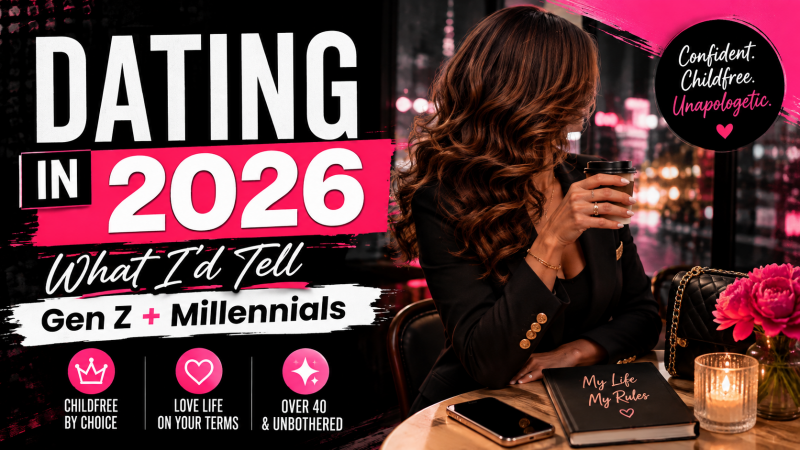
If I could sit Gen Z and Millennial women down for one conversation about dating, I wouldn’t teach them how to get a man.
There is already enough content on the internet for that.
How to text him.
How long to wait before texting him.
How to make him miss you.
How to become “irresistible.”
How to decode the fact that he watched your Instagram Story at 11:43 p.m. but apparently lost the use of both thumbs when it came time to answer your message.
No.
What I would talk about is something I think becomes much clearer with age:
Finding someone and choosing someone are two completely different skills.
And choosing well matters far more.
I’m over 40, childfree by choice, and I’ve had enough life experience to understand something I certainly didn’t understand as clearly when I was younger: the person you choose can dramatically affect the quality of the life you’re trying to build.
So if I could send a little wisdom backward through the generational group chat, this is what I’d say.
Dating Has Changed. Human Nature Hasn’t.
Dating in 2026 comes with technology I couldn’t have imagined when I first entered the dating world.
You can swipe through hundreds of people while sitting on the sofa eating noodles.
You can investigate somebody’s Instagram, LinkedIn, TikTok and possibly his aunt’s Facebook page before the first appetizer arrives.
You can ask AI what his text meant.
Technology has changed the mechanics of meeting.
It has not magically upgraded human beings.
People still want to be loved.
People still fear rejection.
People still avoid difficult conversations.
People still confuse lust with love.
And people are still capable of ignoring a red flag large enough to be seen from the International Space Station because somebody is gorgeous.
Some things apparently survive every technological revolution.
Online dating is deeply embedded in younger generations’ dating experience. Pew Research Center found in its nationally representative research that 53% of U.S. adults under 30 had used a dating site or app. (Pew Research Center)
And despite all the jokes about modern dating being hopeless, younger people haven’t abandoned romance.
In research released by Tinder in February 2026, the company reported that 80% of the Gen Z singles it surveyed believed they would find true love, and 74% believed they would eventually marry. That’s company research rather than an independent national survey, but it certainly doesn’t sound like a generation that has given up on love. (Tinder Press Room)
So my advice isn’t to become cynical.
Quite the opposite.
Believe in love. Just become better at selecting the person you’re going to give it to.
Chemistry Is Not Compatibility
I wish this distinction were tattooed somewhere temporarily visible during the first six months of every new relationship.
Chemistry is wonderful.
I’m a fan.
Butterflies, attraction, flirting, longing, that little electricity when someone walks into a room?
Lovely.
We are not trying to turn dating into an IRS audit.
But chemistry tells you that you’re attracted to someone.
It does not tell you that you can build a life with them.
You can have tremendous chemistry with someone who is emotionally unavailable.
You can have chemistry with somebody whose financial habits terrify you.
You can have chemistry with someone who wants six children when you want zero.
You can have chemistry with someone who considers communication a seasonal activity.
That’s why compatibility eventually has to walk into the room and ask chemistry a few uncomfortable questions.
What are your values?
How do you handle money?
Do you want marriage?
Do you want children?
How do you handle conflict?
What does fidelity mean to you?
What kind of life are you trying to create?
How do you treat people when you’re angry?
Research on healthy relationships consistently points toward qualities considerably less cinematic than butterflies. The American Psychological Association emphasizes open communication as an important part of maintaining healthy romantic relationships, while relationship research has repeatedly examined the importance of feeling understood, cared for and validated by a partner. (American Psychological Association)
That may not sound as sexy as “instant connection.”
Give it time.
Being deeply understood by someone becomes extremely sexy.
Watch What Happens When He Doesn’t Get His Way
If I could give younger women one dating shortcut, this might be it:
Do not evaluate someone only when everything is going well.
Anybody can be delightful over cocktails when the lighting is flattering and the appetizers have arrived on time.
Watch what happens when something goes wrong.
Watch him when he is frustrated.
Watch him when you disagree with him.
Watch him when someone tells him no.
Watch him when you establish a boundary.
Watch him when another person has something he wants.
Watch how he talks about former partners.
Watch how he treats people he doesn’t need to impress.
That version of someone tells you much more than his dating résumé.
I have learned that character frequently introduces itself through inconvenience.
The restaurant lost the reservation?
Wonderful.
Not wonderful for dinner, obviously.
But potentially excellent research.
Stop Dating Potential
This one deserves its own congressional hearing.
Please stop falling in love with potential.
Potential has wasted enough women’s time to qualify for a pension.
When you meet someone, pay attention to the person who actually exists.
Not the imaginary man you have created after mentally improving his communication skills, ambition, finances, emotional maturity, haircut and relationship with his mother.
That gentleman does not exist.
You built him.
And now you’re dating your own renovation plans.
There’s nothing wrong with growing alongside another human being. Healthy relationships should allow both people to evolve.
But there is a massive difference between:
“This is a good man who is still growing.”
and:
“This relationship would be wonderful if he became a completely different person.”
I believe women sometimes fall into the second trap because we’re very good at seeing possibilities.
That quality is terrific in business, art and home renovation.
It requires considerably more supervision in dating.
Decide What You Want Before Attraction Starts Negotiating With You
This is especially important when it comes to marriage and children.
I knew relatively young that motherhood wasn’t the life I wanted.
That meant a man who deeply wanted children could be handsome, intelligent, kind, funny and wonderful…
…and still be wrong for me.
Nobody has to be the villain.
That is something I wish more people understood about compatibility.
Sometimes two perfectly decent people want fundamentally different lives.
And neither person should have to surrender something enormous to keep the relationship.
If you know you want children, that matters.
If you know you don’t want them, that matters.
If you want marriage, say so.
If you genuinely don’t care about marriage, say so.
If monogamy is important to you, know that.
If your career is central to the life you want, don’t pretend it isn’t because you’re afraid somebody might find your ambition inconvenient.
Your fundamental desires should not become embarrassing secrets you slowly reveal after somebody has already fallen in love with you.
Interestingly, Tinder’s own trend report for 2026 describes a movement it calls “clear-coding,” essentially singles becoming more direct about what they want and expect from relationships. Again, that’s Tinder’s interpretation of its own user research, but this is one modern dating trend I wholeheartedly endorse. (Tinder Press Room)
Clarity saves time.
And at this point in my life, I have developed a deep appreciation for anything that saves time.
Don’t Turn Dating Into Online Shopping
Dating apps have given people access to enormous numbers of potential partners.
That sounds wonderful until human beings start behaving like products in an endless catalog.
Next.
Next.
Next.
His laugh is strange.
Next.
She used the wrong emoji.
Next.
His shoes offended me spiritually.
Next.
Preferences are perfectly legitimate. Attraction matters.
But there is a difference between having standards and developing a shopping mentality toward human beings.
Tinder commissioned research in the UK in 2025 that found 67% of surveyed singles ages 18 to 34 said they had written someone off too quickly because of an “ick” and later regretted it. Because this was Tinder-commissioned research in one country, I wouldn’t treat it as a universal law. But I find the idea fascinating. (Tinder UK Newsroom)
Sometimes discernment protects you.
Sometimes perfectionism protects you from intimacy.
Wisdom is learning the difference.
A man being controlling?
Problem.
A man being dishonest?
Problem.
A man having slightly unfortunate sneakers?
We may need additional evidence.
Never Confuse Anxiety With Passion
This is something many of us learn later than we should.
If someone constantly leaves you wondering where you stand, that uncertainty itself can become emotionally intoxicating.
They disappear.
Then return.
They’re affectionate.
Then distant.
They want you.
Then they “need space.”
Now you’re analyzing texts with three girlfriends and enough screenshots to assist the FBI.
That intensity can feel like extraordinary chemistry.
But emotional instability and romantic depth are not synonyms.
One of the things relationship science has studied is perceived partner responsiveness: the feeling that your partner understands you, cares about you and values what you are experiencing. Research has repeatedly associated that responsiveness with relationship intimacy and satisfaction. (PubMed Central (PMC))
That fascinates me because it reinforces something experience teaches eventually:
Peace is not boring when you’ve chosen the right person.
Chaos merely makes more noise.
Pay Attention to How You Feel Around Them
Not just how you feel about them.
That difference is enormous.
You can feel wildly attracted to someone while feeling terrible around them.
Ask yourself:
Do I feel respected?
Can I speak freely?
Can I disagree?
Do I feel emotionally safe?
Can I be myself?
Am I constantly performing?
Am I becoming smaller to make this relationship work?
Do I like myself when I’m with this person?
That last question doesn’t get nearly enough attention.
Sometimes we’re so busy determining whether someone likes us that we forget to ask whether we like the version of ourselves that appears around them.
Stop Treating Being Single Like an Emergency
This may be the most important advice I can offer.
Do not choose a relationship from fear.
Fear that everybody else is getting married.
Fear that your friends are having babies.
Fear that you’re running out of time.
Fear that you’ll never meet anyone else.
Fear that this person is your “last chance.”
Scarcity makes terrible romantic decisions.
If you believe you must make this relationship work because nothing else might come along, you will negotiate things that clarity would never negotiate.
Being single is not an emergency.
And a relationship is not automatically evidence that you’ve succeeded at life.
I say that as a woman who has built an identity and a life that were never centered around becoming somebody’s wife or somebody’s mother.
Love can be beautiful.
Partnership can be beautiful.
So can independence.
The goal is not to acquire a relationship so you can hold it up as proof that somebody chose you.
The question is whether you chose wisely, too.
Keep Your Own Life
Please keep your friends.
Keep your interests.
Keep your ambitions.
Keep learning.
Keep earning.
Keep traveling if travel matters to you.
Keep building your financial independence.
Keep doing things that belong specifically to you.
Love does not require the disappearance of the person who fell in love.
I think this is especially important for women because previous generations were often socialized to organize enormous portions of their identities around relationships and caregiving.
Younger women have an opportunity to write a different script.
You can love deeply without evaporating.
Don’t Let Social Media Choose Your Relationship
Your relationship does not need to make sense to strangers.
And strangers do not need a front-row seat.
One of the stranger developments of modern romance is that relationships can become content.
The announcement.
The soft launch.
The hard launch.
The vacation slideshow.
The anniversary post.
The breakup statement.
The cryptic quote afterward.
At some point I would like everyone to put the telephone down and go have dinner.
Social media can make a relationship look extraordinary.
But relationships are actually lived during the parts nobody uploads.
Tuesday morning.
Bills.
Illness.
Bad moods.
Career setbacks.
Family problems.
Laundry.
The real relationship exists outside the highlight reel.
Choose for that life.
Listen to Your Friends, But Keep Your Own Brain
I value girlfriends enormously.
Sometimes a friend can see something we can’t because we’re standing too close to it.
But relationships are also not democracies.
Your friends don’t get twelve electoral votes.
Listen when several people who genuinely love you independently notice the same troubling pattern.
Then investigate it yourself.
Likewise, don’t reject a perfectly good partner simply because your social circle wouldn’t personally date him.
They’re not supposed to.
You are.
Attraction Matters. Character Matters Longer.
I am never going to sit here and tell women physical attraction doesn’t matter.
Please.
We are adults.
Eyes work.
But attraction gets somebody through the front door.
Character determines whether you’ll eventually want them sitting on your sofa.
The qualities that become enormously important over time are often the ones that don’t photograph particularly well:
Reliability.
Kindness.
Humor.
Integrity.
Emotional intelligence.
Curiosity.
Accountability.
Generosity of spirit.
Can they apologize?
Can they tell the truth when the truth is uncomfortable?
Can they celebrate your success without needing to reduce you afterward?
Can they disagree without punishing you?
Can they laugh?
Can they grow?
Those questions aren’t boring.
They’re expensive questions if you answer them incorrectly.
And Finally: Choosing Yourself Is Also an Option
I think younger women should hear this more often.
A relationship does not have to work simply because you invested time in it.
You are allowed to change your mind.
You are allowed to discover that something isn’t right for you.
You are allowed to leave a relationship that looks perfectly acceptable from the outside.
You are allowed to want something different.
You are even allowed to create a fulfilling life that never revolves around marriage or children at all.
There isn’t one correct blueprint for womanhood.
That realization has given me enormous freedom.
What I Know Now About Love
If I could reduce everything I’ve learned to one sentence, it would be this:
Do not spend your dating life trying to become desirable enough to be chosen. Spend some of that energy becoming discerning enough to choose well.
Those are very different pursuits.
Younger me probably thought the exciting question was:
“Does he want me?”
Older me knows there is another question sitting quietly beside it:
“Do I want what comes with him?”
His values.
His character.
His habits.
His emotional life.
His vision for the future.
His way of loving.
His way of handling conflict.
His way of moving through the world.
Because you’re not just choosing a person.
You’re choosing the experience of yourself that will exist beside that person.
And that, Gen Z and Millennials, is where I would tell you to become extraordinarily selective.
Not cynical.
Not impossible to please.
Not afraid of love.
Just awake.
Finding somebody isn’t the victory.
Choosing well is.
Your Turn
What dating lesson did you learn through experience that you wish someone had told you when you were younger?
And if you’re Gen Z or a Millennial, what’s one piece of dating advice from older women you think your generation should hear more often?
Tell me in the comments. This is one conversation where I suspect the generations have quite a lot to teach each other.
#DatingAdviceForWomen #WomenOver40 #ModernDating #ChildfreeWomen #FortyPlusAndChildfree
Add comment
Comments